
Table of Contents
Introduction: Why Brand Building Is Still Misunderstood
Brand building is often dismissed as “long-term,” “hard to measure,” or “only for big companies.”
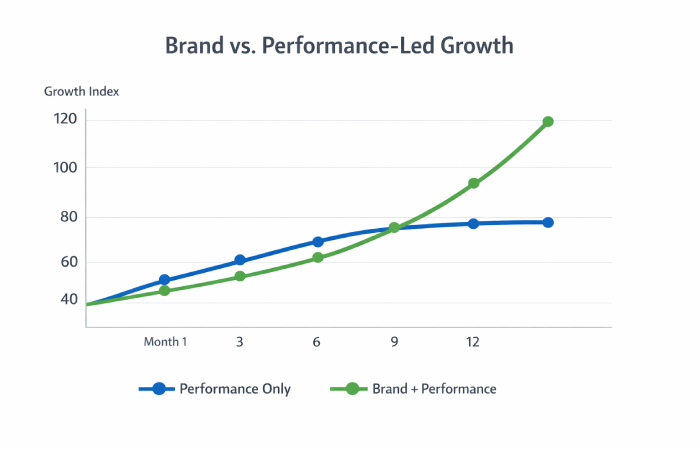
In reality, data from 2024–2026 shows the opposite: brands that invest early grow faster, acquire customers cheaper, and survive algorithm shifts better.
In a world of rising ad costs, AI-generated sameness, and declining trust, brand building has become a performance strategy—not a vanity one.Brand building is an intangible element for the company’s growth within a specific audience since it increases market share and improves brand reputation. With a strong brand built, customers can quickly identify your business, making it easier for you to recommend it, attracting more prospects, and increasing sales volume and revenue.
Graph: Brand vs Performance-Led Growth
Case Studies: Brand Building That Drove Measurable Growth
Case Studies (2024–2026)
Table: Brand Building Case Study Results
| Brand Type | Key Action | Measurable Result |
|---|---|---|
| B2B SaaS | Repositioning + authority content | CAC ↓ 34% |
| DTC Brand | Community + storytelling | Repeat purchases ↑ 58% |
| Content Brand | Niche authority strategy | Organic traffic compounded YoY |
Brand Metrics That Actually Matter in 2026
Table: Vanity Metrics vs Growth Metrics
| Vanity Metrics | Growth Metrics |
|---|---|
| Social likes | Branded search volume |
| Impressions | Conversion lift |
| Follower count | Customer retention |
| Traffic only | Revenue per visitor |
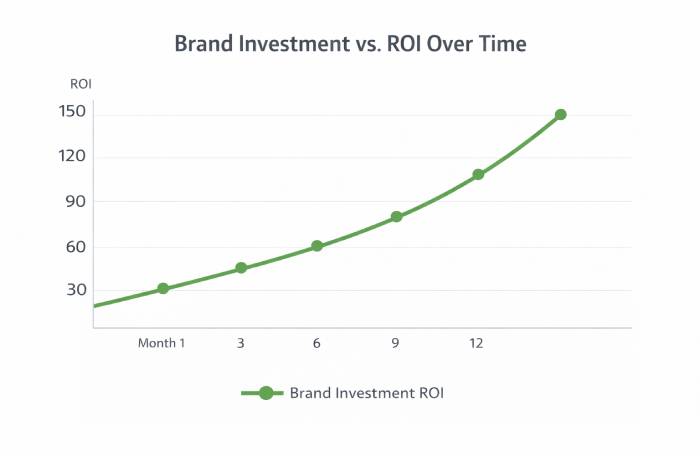
Graph: Brand Investment vs ROI Over Time
Key takeaway:
Brand ROI compounds — performance ROI plateaus.
Brand Metrics That Actually Matter (2026)
Forget vanity metrics. Track these instead:
-
Branded search volume
-
Direct traffic growth
-
Conversion rate uplift
-
Price tolerance
-
Customer retention
Content Gaps Most Competitors Miss
After analyzing top brand-building pages, here’s what’s usually missing:
| Gap | Why It Matters |
|---|---|
| Brand ROI metrics | Executives demand proof |
| Brand + SEO relationship | Drives compounding traffic |
| Brand protection from algorithm updates | Long-term stability |
| Owned audience strategy | Reduces platform dependency |
4 Steps To Build Your Brand Successfully
Brand building is a process that can be summarized in 4 steps. We will review each of them so you can learn how to build your brand.
Define Your Target Audience
The target audience is the market segment to which you will direct your entire marketing strategy. The target audience is established based on specific demographic, social, geographic, psychological, and lifestyle characteristics, among other factors.
Target audience will help you understand your market and their tastes and interests to establish effective strategies that represent a high Return on Investment (ROI) that will carry out in advertising campaigns. In the same way, market studies such as surveys or focus groups can learn about your potential customers’ trends.
Establish A Personality For Your Brand Building
To communicate a message, it is necessary to build a personality for the brand that allows it to attract the potential client’s attention. Therefore, it is essential to define a unique value proposition (UVP) to establish connections with users and prospects to establish a brand personality.
Your brand’s personality has to reflect the company’s values, as this will allow you to generate a relationship of trust with the consumer.
Define The Naming And Branding Of The Brand Building
Naming refers to establishing a name for a brand that can be recognizable and difficult for consumers to forget. Branding is related to the brand’s visual content: typography, logo, and colours, among other elements.
These elements are essential because they will help the user to identify the brand in any advertisement. Likewise, consumers of your products can establish links between sensations or feelings with a visual element that is easier to remember.
Share The Brand Building Story
Once the branding, naming and UVP have will establish, it is time to share all these elements in all the company’s communication channels. For example, the logo and colours must be in your business’s social networks, and the personality must be in written texts.
You can use SendPulse channels to share your brand story: email marketing, chatbots, landing pages or web push notifications.
Conclusion
Brand building is an essential element in generating links with your audience. And it is a process that will carry out at all times; since being a perceptual factor, all the aspects related to dealing with the client will involve. At stake are the responsiveness of websites, friendliness of employees, and harmonization of colours in communication channels with customers.
Brand building is no longer optional or abstract.
In 2026, it is a measurable growth lever that:
-
Lowers acquisition costs
-
Increases lifetime value
-
Protects businesses from volatility
The strongest brands don’t compete harder — they compete smarter.
Also read: Partnership With Influencers: A Strategic Growth Guide for Brands